Designing Beyond the Conventional Office
Global Capability Centres (GCCs) in India are evolving into strategic hubs for technology, engineering, research, product development and digital innovation. As their role expands, the workplace must do more than accommodate employees. It must support collaboration, focused work, wellbeing and changing business needs while responding to sustainability goals and long-term operational performance.
This shift is reshaping GCC workplace design. The key question is no longer simply how to create a green office, but how to design an environment that uses resources responsibly, supports its people and remains adaptable over time. At MAP Architects, we see this as an opportunity to bring architecture, research and technology together from the earliest stages of design.
1. Climate-Responsive Design Starts With Architecture
Sustainability is most effective when it informs the fundamental planning of a building, rather than being treated as a set of features added later. Orientation, building massing, façade design, shading, daylight, landscape and material selection all influence a building’s relationship with its environment.
A GCC in Bengaluru may require a different architectural response from one in Hyderabad, Chennai or another city. Local climate, sun path, rainfall, wind, vegetation and urban conditions should inform design decisions, even when the workplace follows global corporate standards. Global consistency need not mean identical buildings everywhere.
A climate-responsive approach can help reduce unwanted heat gain and make better use of daylight and outdoor conditions where appropriate. It also encourages teams to consider energy demand at the planning stage, before relying on building systems or renewable energy to address performance.
2. Technology-Enabled Design and BIM Coordination
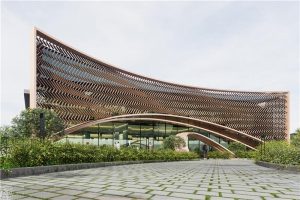
Digital tools are changing how architects test ideas and coordinate complex projects. Parametric and computational design can help teams compare alternatives, exploring how changes in building form, façade depth or orientation may affect environmental response. AI-driven design and smart optimisation can support the evaluation of options, with project-specific performance claims verified before publication.
Building Information Modelling (BIM) also plays an important role in coordinating information and identifying potential conflicts earlier in the design process. This is particularly valuable for GCC developments involving multiple stakeholders, consultants and delivery teams. MAP Architects has used BIM since 2011 and reports more than 30 million sq. ft. of projects delivered using BIM technology.
When used thoughtfully, these workflows support collaboration, accuracy and informed decision-making. The larger opportunity is to connect design and coordination with construction and building operation, making technology an enabler of better lifecycle decisions—not simply a documentation tool.
3. Human-Centric and Adaptable Workplaces
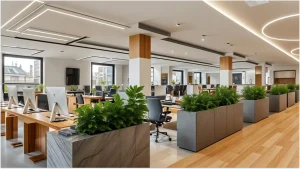
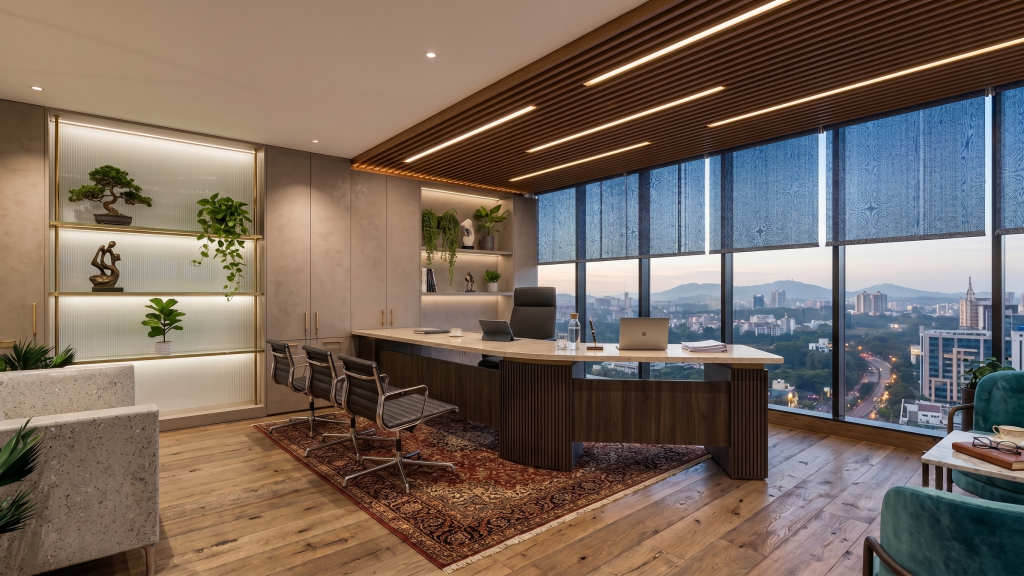
A sustainable workplace must work well for the people who use it. Daylight, air quality, thermal comfort, acoustics, views, greenery, privacy and spaces for collaboration all influence everyday experience. GCCs bring together teams with different needs, so the workplace should offer a considered balance of focused work areas, meeting spaces, informal collaboration and shared amenities.
Adaptability is equally important. GCC teams, technologies and operating models can change significantly over time. Flexible floor plates, modular planning, reconfigurable partitions and multi-purpose spaces can help a workplace respond to those changes without requiring extensive reconstruction. Planning for change can extend a building’s useful life and reduce avoidable material waste.
At MAP Architects, the EASE© approach—Environment, Affordability, Signature and End-user comfort—reflects the need to balance environmental considerations with the identity, practical needs and experience of the people who use a space.
4. Materials, Resource Efficiency and Lifecycle Thinking
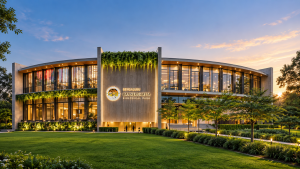
Material choices have consequences beyond appearance and initial cost. Sourcing, durability, maintenance, transport, reuse and end-of-life disposal all contribute to a material’s wider impact. Local and durable materials, lower-impact finishes, reusable components and careful construction planning can help reduce waste and support a more circular approach to design.
The same whole-building mindset applies to energy. Net-zero thinking should begin by reducing demand through climate-responsive planning and an efficient building envelope, then optimising lighting and building systems, and finally considering renewable energy where appropriate. No single technology makes a building sustainable; the stronger outcome comes from coordinated decisions across design, materials and operation.
For GCCs, these choices can support resource efficiency, workplace quality, ESG objectives and long-term relevance. They also underline why sustainability should be considered from the beginning of a project and revisited throughout its lifecycle.
The Future of GCC Architecture Is Intelligent and Human-Centred
The next generation of GCC workplaces will be shaped by how effectively architecture connects climate, technology, people and business needs. Climate-responsive design can reduce environmental loads; digital workflows can improve coordination; human-centric planning can strengthen workplace experience; and adaptable spaces can respond to change.
MAP Architects approaches projects through Design, Research and Technology, bringing together capabilities that include master planning, architectural design, interior design, landscape design and BIM. For GCCs, this integrated perspective helps frame sustainability not as a checklist, but as part of how a project is conceived and developed.
The future GCC should not simply be a place where people work. It should be a workplace that works better—for people, for business and for the planet.